
Sustainable Workwear: Why the Circular Economy is the Future of Your Team's Uniform
If you’ve spent any time on a construction site, in a manufacturing plant, or managing a fleet of service engineers, you know that workwear takes a beating. From grease and grime to the general wear and tear of a twelve-hour shift, uniforms are often seen as "disposable" tools of the trade. You buy them, you wear them until they fall apart, and then you bin them.
But the world is changing. At Office Business Supplies, we’ve seen a massive shift in how companies think about their gear. It’s no longer just about finding the cheapest polo shirt or the toughest pair of boots. Today, it’s about sustainability: not as a buzzword, but as a practical, money-saving business strategy.
That’s where the Circular Economy comes in. It sounds like something out of a university textbook, but it’s actually a very simple, common-sense way of looking at your team's uniform. In this post, we’re going to break down what it means, why it matters for your green credentials, and how brands like Uneek, Russell, and Regatta are helping businesses like yours lead the charge.
What Exactly is the Circular Economy?
In the old days (and for many still today), the economy was "linear." We took raw materials, made a product, and then threw it away when we were done. Take, make, waste.
The Circular Economy flips that on its head. It’s based on three simple principles applied to your workwear: Reduce, Reuse, and Recycle.
- Reduce: This means choosing garments that last longer so you don't have to replace them as often. Every month a jacket stays in service is a month it isn't in a landfill.
- Reuse: This involves repairing clothes when a zip breaks or a seam rips, rather than just ordering a new one. It also means having a system where garments can be cleaned and re-issued if a staff member leaves (provided they are still in good nick!).
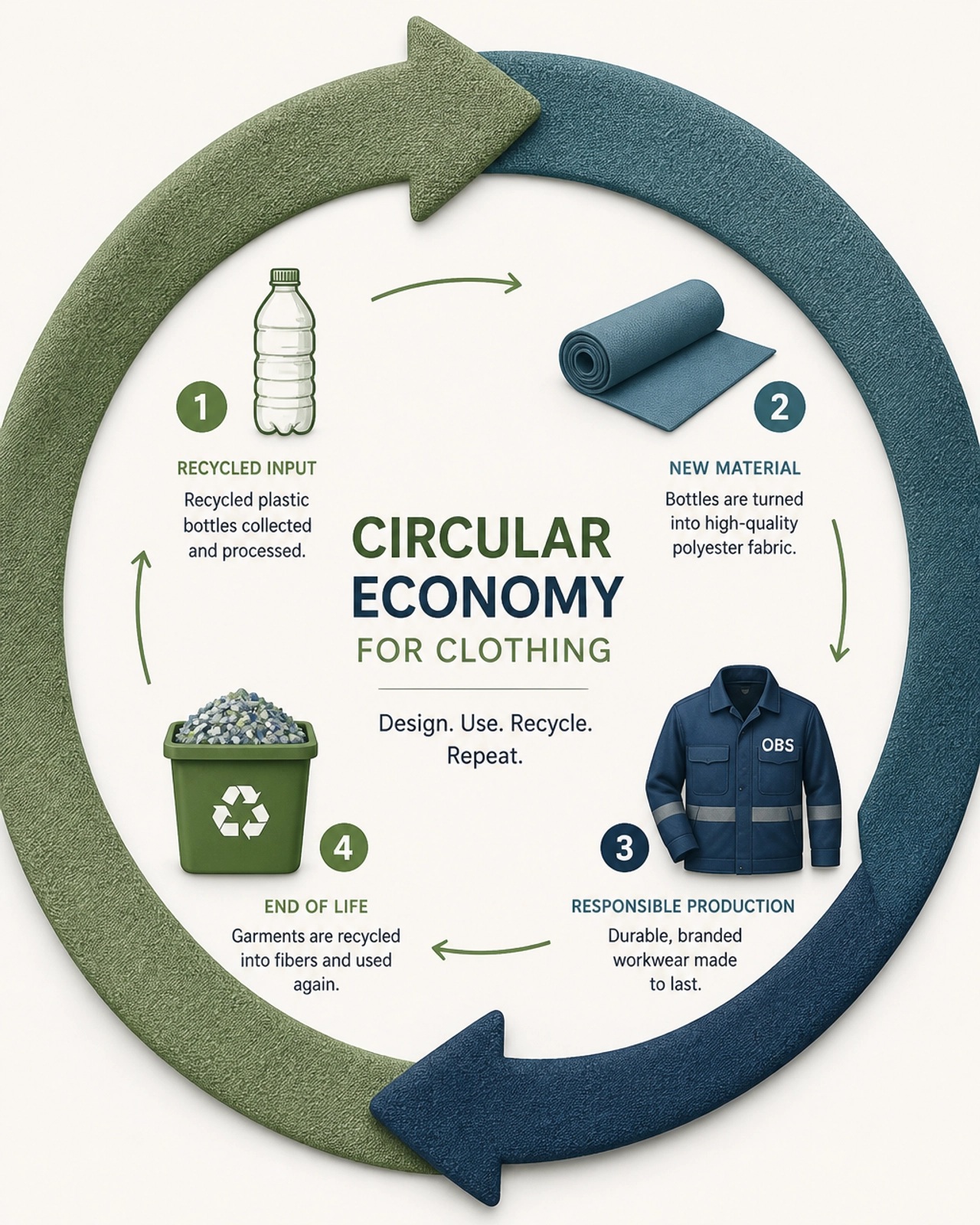
- Recycle: When a piece of clothing truly reaches the end of its life: maybe it’s torn beyond repair or too stained to be professional: it shouldn't go in the general waste. In a circular system, that fabric is shredded and turned into something else, like insulation or even new yarn for new clothes.
Durability: The Secret Ingredient to Sustainability
One of the biggest misconceptions about being "green" is that you have to buy expensive, delicate fabrics. In the world of workwear, the most sustainable thing you can do is buy quality.
If you buy a cheap, unbranded polo shirt that loses its shape after three washes, you’re creating waste. You’ll have to buy three of them in the time one high-quality shirt would have lasted. This is why we stock brands like Uneek and Russell.
Take the Russell Authentic range or Uneek’s heavyweight polos. These aren’t just designed to look sharp; they are built for the industrial environment. They use high-quality cotton and polyester blends that hold their colour and structure. By choosing a more durable garment, you are inherently participating in the circular economy by reducing the volume of clothes your company consumes.
When your engineers are out on a customer site, they need to look professional. A faded, sagging collar doesn't just look bad; it signals that the garment is ready for the bin. High-quality embroidery (which we offer here at Office Business Supplies) also lasts longer than cheap screen prints, keeping your branding crisp for the entire life of the garment.
From Plastic Bottles to High-Performance Fabrics
You’ve probably heard of recycled polyester, but did you know your next hi-vis jacket might have once been a pile of water bottles?
Brands like Regatta Professional and Uneek are leading the way with "rPET" (recycled Polyethylene Terephthalate). This is polyester made from post-consumer plastic waste. Instead of those bottles ending up in the ocean or a hole in the ground, they are collected, shredded into flakes, melted down, and spun into high-performance fibers.
The best part? You can’t tell the difference. Recycled polyester is just as tough, just as moisture-wicking, and just as easy to brand as virgin polyester. When you choose a Regatta Honestly Made fleece or jacket, you’re giving a second life to plastic waste while keeping your team warm and visible on site.
The "End-of-Life" Problem: What Happens to Old Branding?
One of the biggest hurdles for companies in the construction and maintenance sectors is what to do with old uniforms that have a company logo on them. You can’t just drop them off at a charity shop because of security risks: you don’t want a stranger walking onto a site wearing your company's official branded jacket.
In a linear economy, these garments are incinerated or landfilled. In a circular economy, they have a "next life."
Specialised recycling partners can take your old branded workwear and put it through a heavy-duty shredder. The resulting "shoddy" (the industry term for shredded textile waste) is used for:
- Acoustic insulation in cars and buildings.
- Stuffing for mattresses or furniture.
- Industrial rags for cleaning machinery.
Some advanced recyclers are even able to separate the fibers to create new "circular" yarn. By setting up a collection bin at your depot or office, you can ensure your team's old gear stays in the loop.
Why This Matters for Your Business
Beyond the warm, fuzzy feeling of helping the planet, why should a manufacturing or maintenance company care about the circular economy?
1. Improving Your Green Credentials
Many contracts, especially in the public sector or for large tier-1 contractors, now require "Social Value" or "Sustainability" proof. Being able to show that your team wears recycled fabrics and that you have an end-of-life recycling plan can give you a competitive edge in tenders.
2. Health, Safety, and Identification
Sustainability doesn't mean compromising on safety. We still provide top-tier respirators, ear plugs, and hard hats. In fact, many of our sustainable hi-viz options meet the exact same EN ISO 20471 standards as traditional gear. Keeping your team recognisable is vital for site safety, especially in emergencies like fire drills or site evacuations.
3. Team Spirit and Professionalism
There is a psychological benefit to wearing a high-quality, branded uniform. It makes employees feel like they are part of a team. When that team is also committed to a sustainable future, it builds pride in the company. Using brands like Fruit of the Loom, Gildan, or Russell ensures that the fit and feel are consistent, keeping everyone comfortable throughout the day.
How to Get Started
Transitioning to a more circular workwear model doesn't have to happen overnight. Here’s a simple checklist to get you moving:
- Audit your current gear: How long does a polo shirt usually last? If it’s less than six months, consider switching to a more durable brand like Uneek.
- Ask about recycled options: Next time you order fleeces or softshells, ask us about the recycled polyester ranges from Regatta or Russell.
- Think about the logo: Choose embroidery for longevity. It’s harder to damage and stays looking "new" for longer than prints.
- Plan for the end: Set up a "uniform return" box for worn-out items so you can dispose of them responsibly through a textile recycler.
The Future is Circular
At Office Business Supplies, we’re more than just a place to buy toner and notebooks. We’re here to help you kit out your team for the future. Whether you need 500 hi-vis jackets for a new construction project or 10 embroidered fleeces for your maintenance engineers, we can help you find a sustainable, circular solution that keeps your team looking sharp and your conscience clear.
Ready to upgrade your team's workwear? Contact us today for a quote on our sustainable and branded clothing range.
If you’ve spent any time on a construction site, in a manufacturing plant, or managing a fleet of service engineers, you know that workwear takes a beating. From grease and grime to the general wear and tear of a twelve-hour shift, uniforms are often seen as "disposable" tools of the trade. You buy them, you wear them until they fall apart, and then you bin them.
But the world is changing. At Office Business Supplies, we’ve seen a massive shift in how companies think about their gear. It’s no longer just about finding the cheapest polo shirt or the toughest pair of boots. Today, it’s about sustainability: not as a buzzword, but as a practical, money-saving business strategy.
That’s where the Circular Economy comes in. It sounds like something out of a university textbook, but it’s actually a very simple, common-sense way of looking at your team's uniform. In this post, we’re going to break down what it means, why it matters for your green credentials, and how brands like Uneek, Russell, and Regatta are helping businesses like yours lead the charge.
What Exactly is the Circular Economy?
In the old days (and for many still today), the economy was "linear." We took raw materials, made a product, and then threw it away when we were done. Take, make, waste.
The Circular Economy flips that on its head. It’s based on three simple principles applied to your workwear: Reduce, Reuse, and Recycle.
- Reduce: This means choosing garments that last longer so you don't have to replace them as often. Every month a jacket stays in service is a month it isn't in a landfill.
- Reuse: This involves repairing clothes when a zip breaks or a seam rips, rather than just ordering a new one. It also means having a system where garments can be cleaned and re-issued if a staff member leaves (provided they are still in good nick!).
- Recycle: When a piece of clothing truly reaches the end of its life: maybe it’s torn beyond repair or too stained to be professional: it shouldn't go in the general waste. In a circular system, that fabric is shredded and turned into something else, like insulation or even new yarn for new clothes.
Durability: The Secret Ingredient to Sustainability
One of the biggest misconceptions about being "green" is that you have to buy expensive, delicate fabrics. In the world of workwear, the most sustainable thing you can do is buy quality.
If you buy a cheap, unbranded polo shirt that loses its shape after three washes, you’re creating waste. You’ll have to buy three of them in the time one high-quality shirt would have lasted. This is why we stock brands like Uneek and Russell.
Take the Russell Authentic range or Uneek’s heavyweight polos. These aren’t just designed to look sharp; they are built for the industrial environment. They use high-quality cotton and polyester blends that hold their colour and structure. By choosing a more durable garment, you are inherently participating in the circular economy by reducing the volume of clothes your company consumes.
When your engineers are out on a customer site, they need to look professional. A faded, sagging collar doesn't just look bad; it signals that the garment is ready for the bin. High-quality embroidery (which we offer here at Office Business Supplies) also lasts longer than cheap screen prints, keeping your branding crisp for the entire life of the garment.
From Plastic Bottles to High-Performance Fabrics
You’ve probably heard of recycled polyester, but did you know your next hi-vis jacket might have once been a pile of water bottles?
Brands like Regatta Professional and Uneek are leading the way with "rPET" (recycled Polyethylene Terephthalate). This is polyester made from post-consumer plastic waste. Instead of those bottles ending up in the ocean or a hole in the ground, they are collected, shredded into flakes, melted down, and spun into high-performance fibers.
The best part? You can’t tell the difference. Recycled polyester is just as tough, just as moisture-wicking, and just as easy to brand as virgin polyester. When you choose a Regatta Honestly Made fleece or jacket, you’re giving a second life to plastic waste while keeping your team warm and visible on site.
The "End-of-Life" Problem: What Happens to Old Branding?
One of the biggest hurdles for companies in the construction and maintenance sectors is what to do with old uniforms that have a company logo on them. You can’t just drop them off at a charity shop because of security risks: you don’t want a stranger walking onto a site wearing your company's official branded jacket.
In a linear economy, these garments are incinerated or landfilled. In a circular economy, they have a "next life."
Specialised recycling partners can take your old branded workwear and put it through a heavy-duty shredder. The resulting "shoddy" (the industry term for shredded textile waste) is used for:
- Acoustic insulation in cars and buildings.
- Stuffing for mattresses or furniture.
- Industrial rags for cleaning machinery.
Some advanced recyclers are even able to separate the fibers to create new "circular" yarn. By setting up a collection bin at your depot or office, you can ensure your team's old gear stays in the loop.
Why This Matters for Your Business
Beyond the warm, fuzzy feeling of helping the planet, why should a manufacturing or maintenance company care about the circular economy?
1. Improving Your Green Credentials
Many contracts, especially in the public sector or for large tier-1 contractors, now require "Social Value" or "Sustainability" proof. Being able to show that your team wears recycled fabrics and that you have an end-of-life recycling plan can give you a competitive edge in tenders.
2. Health, Safety, and Identification
Sustainability doesn't mean compromising on safety. We still provide top-tier respirators, ear plugs, and hard hats. In fact, many of our sustainable hi-viz options meet the exact same EN ISO 20471 standards as traditional gear. Keeping your team recognisable is vital for site safety, especially in emergencies like fire drills or site evacuations.
3. Team Spirit and Professionalism
There is a psychological benefit to wearing a high-quality, branded uniform. It makes employees feel like they are part of a team. When that team is also committed to a sustainable future, it builds pride in the company. Using brands like Fruit of the Loom, Gildan, or Russell ensures that the fit and feel are consistent, keeping everyone comfortable throughout the day.
How to Get Started
Transitioning to a more circular workwear model doesn't have to happen overnight. Here’s a simple checklist to get you moving:
- Audit your current gear: How long does a polo shirt usually last? If it’s less than six months, consider switching to a more durable brand like Uneek.
- Ask about recycled options: Next time you order fleeces or softshells, ask us about the recycled polyester ranges from Regatta or Russell.
- Think about the logo: Choose embroidery for longevity. It’s harder to damage and stays looking "new" for longer than prints.
- Plan for the end: Set up a "uniform return" box for worn-out items so you can dispose of them responsibly through a textile recycler.
The Future is Circular
At Office Business Supplies, we’re more than just a place to buy toner and notebooks. We’re here to help you kit out your team for the future. Whether you need 500 hi-vis jackets for a new construction project or 10 embroidered fleeces for your maintenance engineers, we can help you find a sustainable, circular solution that keeps your team looking sharp and your conscience clear.
Ready to upgrade your team's workwear? Contact us today for a quote on our sustainable and branded clothing range.