0 £0.00
products in your basketto quote Checkout
Ooops no items were found.
Try something else.
Ok
Loading…

Smart Hard Hats: Is Your PPE Smarter Than Your Phone?

7 min
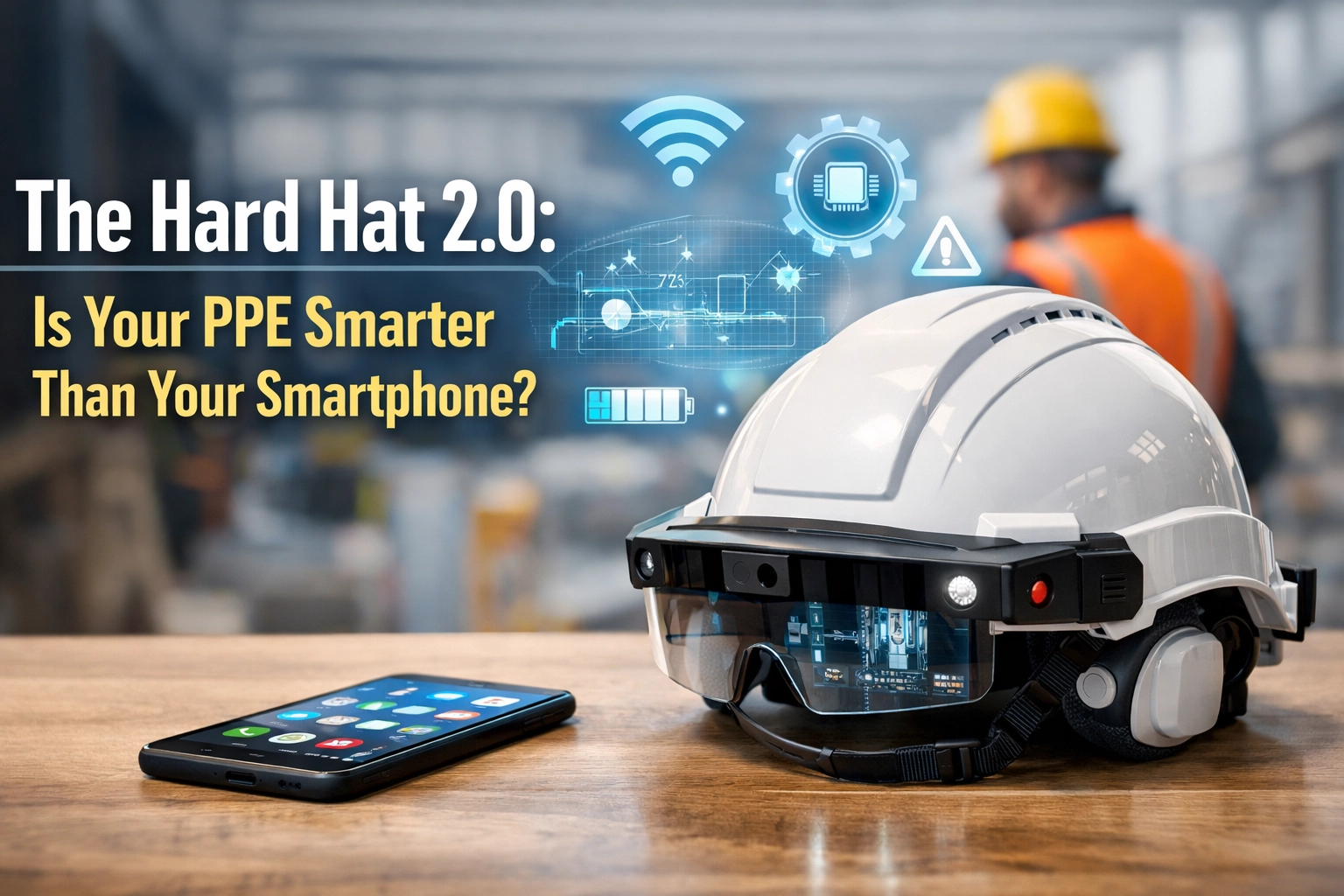
image of a hard hat with wearable technology integrated into it

The Hard Hat 2.0: Is Your PPE Smarter Than Your Smartphone?

For decades, the humble hard hat hasn't changed much. It was a sturdy piece of plastic designed to stop a stray bolt or a falling brick from ruining your day. It did its job, you threw it in the back of the van at 5:00 PM, and that was that. But as we move through 2026, the construction site is looking a lot more like a sci-fi movie set.

The gear we use to stay safe: our PPE equipment: is undergoing a massive digital makeover. We aren't just talking about better materials or more comfortable straps. We’re talking about "Smart Hard Hats." These high-tech helmets are packed with more sensors, cameras, and connectivity than the smartphone sitting in your pocket right now.

At Office Business Supplies, we’re all about the practical side of running a business, but even we have to admit: this stuff is seriously cool. Let’s dive into why the Hard Hat 2.0 is the biggest thing to hit the job site since the invention of the power drill.

From Passive Protection to Active Intelligence

Traditionally, safety equipment was "passive." A pair of ear plugs sits in your ears and blocks noise. A hard hat sits on your head and blocks impact. They don't "do" anything until something goes wrong.

The new generation of smart helmets is "active." They are constantly scanning the environment, monitoring the wearer’s health, and communicating with a central hub. Instead of just protecting you during an accident, they are designed to prevent the accident from happening in the first place.

1. Augmented Reality (AR): Blueprints in Your Eyeline

One of the most mind-blowing features of the 2026 smart helmet is built-in Augmented Reality (AR). Imagine walking onto a site and, instead of fumbling with a tablet or a soggy paper blueprint, you lower a transparent visor.

Suddenly, the 3D BIM (Building Information Modeling) data is overlaid directly onto the physical space around you. You can see exactly where the HVAC ducts are supposed to go, where the electrical runs are hidden behind a wall, or if a structural beam is slightly out of alignment. It turns every worker into an expert and drastically reduces the "measure twice, cut once" anxiety.

2. The Rise of Computer Vision: viAct and AI Monitoring

Hardware is only half the story. The real magic happens when you pair a smart helmet with AI monitoring platforms like viAct.

viAct uses computer vision to transform standard video feeds into a "god-mode" for site safety. By using the cameras mounted on smart hard hats (or fixed site cameras), the AI can automatically detect if a worker isn't wearing their hi-vis clothing, if someone has entered a restricted "red zone," or if a vehicle is getting too close to a pedestrian.

It’s not about "Big Brother" watching you; it’s about having an extra set of eyes that never gets tired, never blinks, and can spot a hazard before a human even realizes it's there.

Keeping a Pulse on the Team: Health & Safety Sensors

In the past, if a worker felt faint from heat stress or slipped in a remote corner of a warehouse, it might be a while before anyone noticed. In 2026, the hard hat is the ultimate first responder.

Fall and Impact Detection

Smart helmets now come equipped with high-precision accelerometers. If a worker takes a tumble, the hat detects the sudden change in motion and the impact force. It can instantly send an emergency alert to the site supervisor with the exact GPS coordinates of the incident. This is a game-changer for lone workers or those operating in massive industrial complexes.

Heat Stress Monitoring

Working in the height of summer is no joke. Smart PPE now includes sensors that sit against the forehead to monitor skin temperature and heart rate. If the tech detects that a worker's body temperature is reaching a dangerous level, it will vibrate or send an audio alert, telling them to take a break and hydrate. It’s practical, life-saving tech that keeps the team running at 100%.

Communication and Security

We’ve all been there: trying to shout over the sound of a generator or a jackhammer. Smart helmets are putting an end to the "WHAT did you say?" dance.

Built-in Audio and Video

Modern helmets feature noise-cancelling bone-conduction headsets. This allows workers to communicate clearly via radio or VOIP without needing to remove their ear plugs. Many also feature 4K front-facing cameras, allowing a remote engineer in a different city to see exactly what the site worker is seeing in real-time. It’s like a "See What I See" Zoom call for construction.

GPS and Site Security

Knowing where everyone is on a massive site is a logistical nightmare. GPS-enabled hard hats allow managers to see a real-time heat map of where the crew is distributed. This is great for efficiency, but even better for security. You can ensure that only authorized personnel are in high-risk areas. If someone wanders where they shouldn't be, their hat can give them a polite "wrong way" chirp.

For managing site access, we still recommend the classics like a visitors badge for office guests, but for the boots-on-the-ground crew, the helmet is the new ID card.

Integrating the Old with the New

While we love the high-tech stuff, you can't ignore the fundamentals of safety equipment. A smart helmet is great, but it works best when part of a complete safety ecosystem.

  • Lighting: Even the best AR visor needs light to work with. Having high-quality torches on hand for dark corners is still a site essential.
  • Documentation: Even with digital blueprints, most supervisors still swear by notebooks for quick sketches or daily logs. Tech fails, but paper doesn't need a battery.
  • Visibility: A smart hat is useless if the wearer is invisible. High-quality hi-vis clothing remains the foundation of site safety. The AI monitoring we mentioned earlier relies on that bright neon fabric to "see" and track workers effectively.

Is It Worth the Investment?

You might be thinking, "Susann, this sounds expensive." And you’re right: smart PPE isn't cheap compared to a £20 plastic shell. However, the ROI (Return on Investment) is where it gets interesting for business owners.

Think about the cost of a single site accident:

  1. Project Delays: Work stops, investigations happen, and deadlines blow out.
  2. Insurance Premiums: One major claim can send your rates through the roof.
  3. Legal Fees: We don't even want to go there.
  4. The Human Cost: You can't put a price on keeping your team safe and healthy.

When you factor in the increased productivity from AR and the massive reduction in accident risk through AI monitoring, the "expensive" hat suddenly looks like a very sensible business decision. It’s about being proactive rather than reactive.

The Future is Already Here

We’ve come a long way from the days of simple leather caps and heavy steel buckets. The Hard Hat 2.0 is a sophisticated piece of PPE equipment that bridges the gap between the physical and digital worlds. Whether it's detecting a fall, showing an engineer where a pipe should go, or alerting a manager that a worker is overheating, this tech is transforming the industry.

At Office Business Supplies, we’re keeping a close eye on these trends. While we might not be stocking AR-integrated helmets in our warehouse just yet, we’re here to make sure you have all the essential safety gear and office tech you need to keep your business running smoothly.

So, is your hard hat smarter than your smartphone? If it isn't yet, it probably will be by the end of the year!

Ready to upgrade your site safety or just need to restock the basics? Browse our full range of safety equipment today and keep your team protected.

Smart Hard Hats: Is Your PPE Smarter Than Your Phone?

7 min
image of a hard hat with wearable technology integrated into it

The Hard Hat 2.0: Is Your PPE Smarter Than Your Smartphone?

For decades, the humble hard hat hasn't changed much. It was a sturdy piece of plastic designed to stop a stray bolt or a falling brick from ruining your day. It did its job, you threw it in the back of the van at 5:00 PM, and that was that. But as we move through 2026, the construction site is looking a lot more like a sci-fi movie set.

The gear we use to stay safe: our PPE equipment: is undergoing a massive digital makeover. We aren't just talking about better materials or more comfortable straps. We’re talking about "Smart Hard Hats." These high-tech helmets are packed with more sensors, cameras, and connectivity than the smartphone sitting in your pocket right now.

At Office Business Supplies, we’re all about the practical side of running a business, but even we have to admit: this stuff is seriously cool. Let’s dive into why the Hard Hat 2.0 is the biggest thing to hit the job site since the invention of the power drill.

From Passive Protection to Active Intelligence

Traditionally, safety equipment was "passive." A pair of ear plugs sits in your ears and blocks noise. A hard hat sits on your head and blocks impact. They don't "do" anything until something goes wrong.

The new generation of smart helmets is "active." They are constantly scanning the environment, monitoring the wearer’s health, and communicating with a central hub. Instead of just protecting you during an accident, they are designed to prevent the accident from happening in the first place.

1. Augmented Reality (AR): Blueprints in Your Eyeline

One of the most mind-blowing features of the 2026 smart helmet is built-in Augmented Reality (AR). Imagine walking onto a site and, instead of fumbling with a tablet or a soggy paper blueprint, you lower a transparent visor.

Suddenly, the 3D BIM (Building Information Modeling) data is overlaid directly onto the physical space around you. You can see exactly where the HVAC ducts are supposed to go, where the electrical runs are hidden behind a wall, or if a structural beam is slightly out of alignment. It turns every worker into an expert and drastically reduces the "measure twice, cut once" anxiety.

2. The Rise of Computer Vision: viAct and AI Monitoring

Hardware is only half the story. The real magic happens when you pair a smart helmet with AI monitoring platforms like viAct.

viAct uses computer vision to transform standard video feeds into a "god-mode" for site safety. By using the cameras mounted on smart hard hats (or fixed site cameras), the AI can automatically detect if a worker isn't wearing their hi-vis clothing, if someone has entered a restricted "red zone," or if a vehicle is getting too close to a pedestrian.

It’s not about "Big Brother" watching you; it’s about having an extra set of eyes that never gets tired, never blinks, and can spot a hazard before a human even realizes it's there.

Keeping a Pulse on the Team: Health & Safety Sensors

In the past, if a worker felt faint from heat stress or slipped in a remote corner of a warehouse, it might be a while before anyone noticed. In 2026, the hard hat is the ultimate first responder.

Fall and Impact Detection

Smart helmets now come equipped with high-precision accelerometers. If a worker takes a tumble, the hat detects the sudden change in motion and the impact force. It can instantly send an emergency alert to the site supervisor with the exact GPS coordinates of the incident. This is a game-changer for lone workers or those operating in massive industrial complexes.

Heat Stress Monitoring

Working in the height of summer is no joke. Smart PPE now includes sensors that sit against the forehead to monitor skin temperature and heart rate. If the tech detects that a worker's body temperature is reaching a dangerous level, it will vibrate or send an audio alert, telling them to take a break and hydrate. It’s practical, life-saving tech that keeps the team running at 100%.

Communication and Security

We’ve all been there: trying to shout over the sound of a generator or a jackhammer. Smart helmets are putting an end to the "WHAT did you say?" dance.

Built-in Audio and Video

Modern helmets feature noise-cancelling bone-conduction headsets. This allows workers to communicate clearly via radio or VOIP without needing to remove their ear plugs. Many also feature 4K front-facing cameras, allowing a remote engineer in a different city to see exactly what the site worker is seeing in real-time. It’s like a "See What I See" Zoom call for construction.

GPS and Site Security

Knowing where everyone is on a massive site is a logistical nightmare. GPS-enabled hard hats allow managers to see a real-time heat map of where the crew is distributed. This is great for efficiency, but even better for security. You can ensure that only authorized personnel are in high-risk areas. If someone wanders where they shouldn't be, their hat can give them a polite "wrong way" chirp.

For managing site access, we still recommend the classics like a visitors badge for office guests, but for the boots-on-the-ground crew, the helmet is the new ID card.

Integrating the Old with the New

While we love the high-tech stuff, you can't ignore the fundamentals of safety equipment. A smart helmet is great, but it works best when part of a complete safety ecosystem.

  • Lighting: Even the best AR visor needs light to work with. Having high-quality torches on hand for dark corners is still a site essential.
  • Documentation: Even with digital blueprints, most supervisors still swear by notebooks for quick sketches or daily logs. Tech fails, but paper doesn't need a battery.
  • Visibility: A smart hat is useless if the wearer is invisible. High-quality hi-vis clothing remains the foundation of site safety. The AI monitoring we mentioned earlier relies on that bright neon fabric to "see" and track workers effectively.

Is It Worth the Investment?

You might be thinking, "Susann, this sounds expensive." And you’re right: smart PPE isn't cheap compared to a £20 plastic shell. However, the ROI (Return on Investment) is where it gets interesting for business owners.

Think about the cost of a single site accident:

  1. Project Delays: Work stops, investigations happen, and deadlines blow out.
  2. Insurance Premiums: One major claim can send your rates through the roof.
  3. Legal Fees: We don't even want to go there.
  4. The Human Cost: You can't put a price on keeping your team safe and healthy.

When you factor in the increased productivity from AR and the massive reduction in accident risk through AI monitoring, the "expensive" hat suddenly looks like a very sensible business decision. It’s about being proactive rather than reactive.

The Future is Already Here

We’ve come a long way from the days of simple leather caps and heavy steel buckets. The Hard Hat 2.0 is a sophisticated piece of PPE equipment that bridges the gap between the physical and digital worlds. Whether it's detecting a fall, showing an engineer where a pipe should go, or alerting a manager that a worker is overheating, this tech is transforming the industry.

At Office Business Supplies, we’re keeping a close eye on these trends. While we might not be stocking AR-integrated helmets in our warehouse just yet, we’re here to make sure you have all the essential safety gear and office tech you need to keep your business running smoothly.

So, is your hard hat smarter than your smartphone? If it isn't yet, it probably will be by the end of the year!

Ready to upgrade your site safety or just need to restock the basics? Browse our full range of safety equipment today and keep your team protected.

SEARCH ×